What Contributions Did the Roman Empire Make in Art
Fine art History and Artists
Ancient Roman Art
History >> Art HistoryCentered in the city of Rome, the civilization of Ancient Rome ruled much of Europe for over thou years. The arts flourished during this time and were often used by the wealthy and powerful to memorialize their deeds and heritage.
Born from Greek Art
The Romans admired the Greek culture and arts. Afterward conquering Greece, they brought many Greek artists to Rome to make sculptures for them in the Greek manner. The art of Aboriginal Greece had a great influence on the fine art of Aboriginal Rome.
Other Influences
Although Greek fine art had the greatest influence on the Romans, other civilizations that they conquered and encountered over their broad empire besides had influence. These included the Aboriginal Egyptians, eastern art, the Germans, and the Celtics.
Roman Sculpture
Roman sculpture played an important role of the Roman daily life. Sculptures took the class of full statues, busts (sculptures of only a person's head), reliefs (sculptures that were part of a wall), and sarcophagi (sculptures on tombs). The Ancient Romans decorated with sculptures in a number of places including public buildings, public parks, and private homes and gardens.
Roman sculpture was heavily influenced by Greek sculpture. In fact, many of the Roman sculptures were just copies of Greek sculptures. The wealthy Romans decorated their large homes with sculptures. A lot of times these sculptures were of themselves or their ancestors. Other popular subjects for sculptures included gods and goddesses, philosophers, famous athletes, and successful generals.
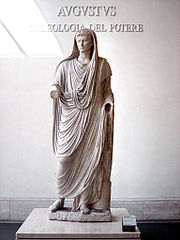
The Via Labicana statue of Augustus
Photo by Ryan Freisling
click picture to see larger view
Above is a marble statue of Augustus the outset Emperor of Rome. He is shown here wearing a traditional Roman toga while performing his duties as Pontifex Maximus.
The Roman Bust
1 of the most pop types of sculpture in Ancient Rome was the bust. This is a sculpture of just the head. Wealthy Romans would put the busts of their ancestors in the atrium of their homes. This was a way for them to show off their lineage.
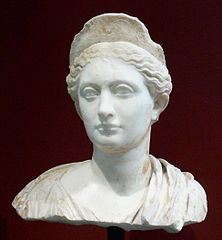
Bust of Vibia Sabina by Andreas Praefcke
Roman Painting
The walls of the homes of wealthy Romans were frequently decorated with paintings. These paintings were frescos painted directly on the walls. Nigh of these paintings have been destroyed over time, but some of them were preserved in the city of Pompeii when information technology was cached by the eruption of a volcano.
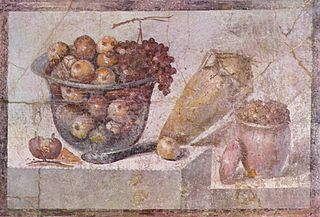
Painting discovered on a wall in the ruins of Pompeii
Source: The Yorck Project
Mosaics
The Romans also made pictures from colored tiles phone call mosaics. The mosaics have been able to survive the test of time amend than the paintings. Sometimes the tiles would be applied direct at the site of the mosaic. Other times the tiles and the base would be fabricated in a workshop and the entire mosaic installed later on. Mosaics could exist art on a wall, merely also worked as decorative flooring.
Legacy
After the Heart Ages, the artists of the Renaissance studied the sculptures, architecture, and art of Ancient Rome and Hellenic republic to inspire them. The classic art of the Romans had a meaning influence on art for many years.
Interesting Facts about Ancient Roman Art
- Sculptures of people became and then popular that artists would mass produce sculptures of bodies without the heads. Then when an order came in for a certain person, they would cleave the head and add it to the sculpture.
- Roman Emperors would often have many statues made in their accolade and placed effectually the urban center. They used this as a way of commemorating their victories and reminding the people who was in power.
- Some Greek statues but survive through the copies that the Romans had made.
- Rich Romans would have their stone coffins covered with ornate carvings.
- Take a ten question quiz nearly this page.
- Listen to a recorded reading of this page:
Works Cited
History >> Fine art History >>Ancient Rome for Kids
0 Response to "What Contributions Did the Roman Empire Make in Art"
Enviar um comentário